

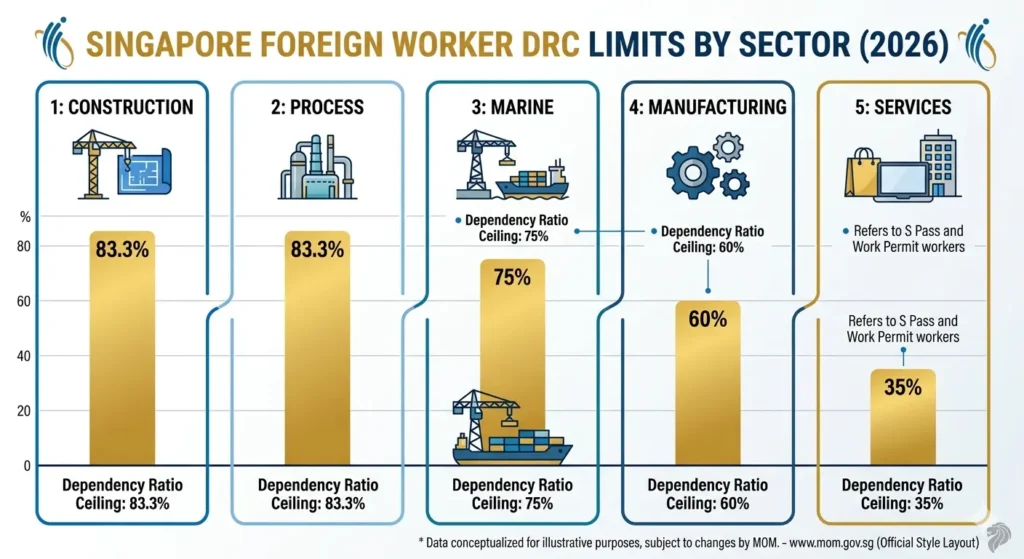
The Dependency Ratio Ceiling (DRC) sets the limit on your foreign worker quota in Singapore – the maximum percentage of your total workforce that can be foreign workers. The DRC is sector-dependent: Construction and Process firms can go to 83.3%. Manufacturing to 60%. Services only to 35%. Employers in the construction industry also need Man-Year Entitlement (MYE) to hire from particular source countries. Get your quota calculation wrong and you could be facing rejected work pass applications, MOM penalties and even hiring bans.
What Is the Foreign Worker Quota in Singapore?
The foreign worker quota in Singapore — officially called the Dependency Ratio Ceiling (DRC) — is the legal limit on how many foreign Work Permit and S Pass holders a company can employ relative to its total local workforce. MOM sets a different DRC for each industry sector based on how labour-intensive it is and how dependent it has historically been on foreign manpower.
The DRC is not a fixed number — it is a percentage of your total headcount. If your company has 20 employees and your sector DRC is 60%, you can have a maximum of 12 foreign workers (Work Permit and S Pass holders combined). If your local headcount drops, your allowable foreign worker count drops with it automatically.
Employment Pass (E Pass) holders are fully exempt from DRC calculations. The quota only applies to Work Permit and S Pass holders. This is an important distinction for employers building a mixed-tier foreign workforce. If you’re just starting out, see our complete guide on how to hire foreign workers in Singapore for the full step-by-step hiring process.
What Is the Dependency Ratio Ceiling (DRC)?
The Dependency Ratio Ceiling is MOM’s primary tool for controlling Singapore’s reliance on foreign labour. It sets the maximum proportion of foreign workers (Work Permit holders and S Pass holders combined) that a company can employ across five regulated industry sectors.
Singapore first introduced foreign worker quotas in the 1970s to manage the city-state’s growing reliance on overseas labour. Since then, MOM has tightened DRC limits repeatedly — Construction and Process dropped from 87.5% to 83.3% in January 2024, and Marine Shipyard fell from 77.8% to 75% in January 2026. The direction of MOM policy is clear: a smaller, higher-skilled foreign workforce over time.
DRC Limits by Sector — March 2026:
| Sector | Overall DRC | S Pass Sub-DRC | NTS Sub-DRC |
| Construction | 83.3% (1:5) | 15% | N/A |
| Process | 83.3% (1:5) | 15% | N/A |
| Marine Shipyard | 75% (1:3) | 15% | N/A |
| Manufacturing | 60% (1:1.5) | 15% | 8% |
| Services | 35% (1:0.54) | 10% | 8% |
The ratios in parentheses show local-to-foreign worker proportions. A 1:5 ratio means for every 1 local employee, you can hire up to 5 foreign workers — which equals 83.3% of your total headcount being foreign.
What Is Man-Year Entitlement (MYE)?
Man-Year Entitlement (MYE) is an additional quota layer that applies specifically to the Construction sector in Singapore. While DRC controls the overall percentage of foreign workers you can hire, MYE controls how many Work Permit holders you can bring in from Non-Traditional Source (NTS) countries like India, Bangladesh, and Myanmar for construction projects.
MYE is allocated based on the value and duration of your construction projects, not just your local headcount. Each project gets a certain number of man-years — effectively, the total amount of work that can be performed by NTS source country workers over the life of the project. Once the man-years are used up, you cannot bring in more NTS workers for that project without applying for additional MYE.
Why MYE matters for construction employers:
- Without MYE, NTS country workers (India, Bangladesh, Myanmar) can only make up 25% of your total Work Permit workforce in construction
- With MYE, you can significantly increase this proportion — and pay a lower levy rate (SGD 700 vs SGD 950 for R2 workers)
- (For the full sector-by-sector levy breakdown, see our guide to Foreign Worker Levy in Singapore 2026.)
- MYE is allocated by BCA (Building and Construction Authority) through MOM’s system based on project contracts awarded
- MYE is a competitive resource — contractors who secure larger project contracts get more MYE allocation
For any construction company that relies on workers from Myanmar, Bangladesh, or India, understanding and managing your MYE allocation is as important as managing your DRC ratio.
How Many Foreign Workers Can I Hire?
The exact number of foreign workers you can hire depends on three factors: your sector DRC, your eligible local headcount, and (for construction) your MYE allocation.
Step 1 — Count your eligible local workers
MOM counts local employees (Singapore Citizens and PRs) who earn at least the Local Qualifying Salary (LQS). From 1 July 2026, the LQS increases from SGD 1,600 to SGD 1,800 per month. Locals earning below LQS do not count toward your quota calculation — which means a pay rise for borderline local employees can directly increase your foreign worker quota.
Step 2 — Apply your sector DRC
Multiply your eligible local headcount by the DRC ratio for your sector.
Step 3 — Check your S Pass sub-quota
Within your overall DRC allowance, S Pass holders are subject to a separate sub-quota. In most sectors, S Pass holders cannot exceed 15% of your total workforce (10% for Services).
Step 4 — For Construction, check your MYE
If you need NTS country workers beyond the 25% without-MYE limit, confirm your MYE allocation through MOM’s WPOL portal before sourcing candidates.

How Is the Quota Calculated from Local Headcount?
Understanding the quota formula is where most employers make mistakes. The calculation is straightforward once you know the inputs — but small errors in local headcount counting lead to significant compliance problems.
The Formula: Maximum Foreign Workers = Eligible Local Headcount × (DRC ÷ (1 − DRC))
Worked Example — Services Company:
- Company has 10 local employees earning above SGD 1,800/month (LQS from July 2026)
- Services sector DRC = 35%
- Formula: 10 × (0.35 ÷ 0.65) = 10 × 0.538 = 5 foreign workers allowed
- Of these 5, S Pass holders cannot exceed 10% of total workforce (15 total) = maximum 1 S Pass holder
Worked Example — Construction Company:
- Company has 20 local employees above LQS
- Construction DRC = 83.3% (ratio 1:5)
- Formula: 20 × 5 = 100 foreign workers allowed (Work Permit + S Pass combined)
- Of these 100, S Pass holders cannot exceed 15% of total workforce = maximum 18 S Pass holders
- NTS country workers (without MYE): limited to 25% of Work Permit headcount
These examples show why the construction sector can sustain much larger foreign workforces than services — a ratio of 1:5 (local:foreign) versus 1:0.54 creates entirely different hiring capacities for companies of the same local headcount.
How Do I Increase My Quota?
There are four practical ways to increase your foreign worker quota in Singapore — all within MOM’s compliance framework.
1. Hire and retain more local workers above LQS
Since quota is calculated from your eligible local headcount, every additional local employee earning above LQS directly increases how many foreign workers you can hire. From July 2026, this means paying locals at least SGD 1,800/month to count them in the calculation.
2. Upgrade workers from R2 to R1 (Higher-Skilled)
While upgrading skill tier does not directly increase your DRC quota, it does reduce your levy cost per worker — freeing up budget that can be redirected to hiring additional local staff, which then expands your quota.
3. Apply for additional MYE (Construction sector)
Construction employers can apply to BCA for additional MYE allocation when awarded new project contracts. Larger or longer-duration projects generate more MYE, allowing more NTS country workers at the lower levy rate.
4. Review your sector classification
Some companies operate across multiple sectors. If your primary business activity qualifies you for a sector with a higher DRC (e.g., reclassifying from Services to Manufacturing), your available quota can increase substantially. This requires a formal sector classification review through MOM.

Key Takeaways:
Managing your foreign worker quota correctly is the foundation of MOM compliance. Get it right and your hiring runs smoothly. Get it wrong and you face rejected applications, penalties, and a hiring freeze at the worst possible time.
- DRC varies by sector — Construction/Process 83.3%, Marine Shipyard 75%, Manufacturing 60%, Services 35%
- Only Work Permit and S Pass holders count toward your DRC — E Pass holders are fully exempt
- Eligible local headcount drives your quota — local employees must earn at least SGD 1,800/month (from July 2026) to be counted
- S Pass holders face a sub-quota — capped at 15% of total workforce in most sectors, 10% in Services
- Construction employers need MYE to hire NTS country workers (India, Bangladesh, Myanmar) beyond the 25% without-MYE limit
- Increasing local headcount above LQS is the most reliable way to expand your foreign worker quota
MOM updates DRC ratios periodically. Always verify the latest sector DRC at mom.gov.sg before making workforce plans or committing to new hires.

Need Help Calculating Your Foreign Worker Quota?
Getting your DRC and MYE calculations right before you start sourcing candidates saves time, money, and compliance risk. 114 Solutions is a MOM-licensed foreign worker agency in Singapore specialising in construction, marine, and process sector manpower. Our team reviews your current workforce, calculates your available quota, and matches you with the right candidates — before you submit a single application.
Get your quota reviewed today: Visit our Employers page or call +65 8112 8544. Explore our full range of manpower services for construction, industrial, and safety professional recruitment.